Facebook Lead Forms vs. Landing Pages for Service Businesses (2026)
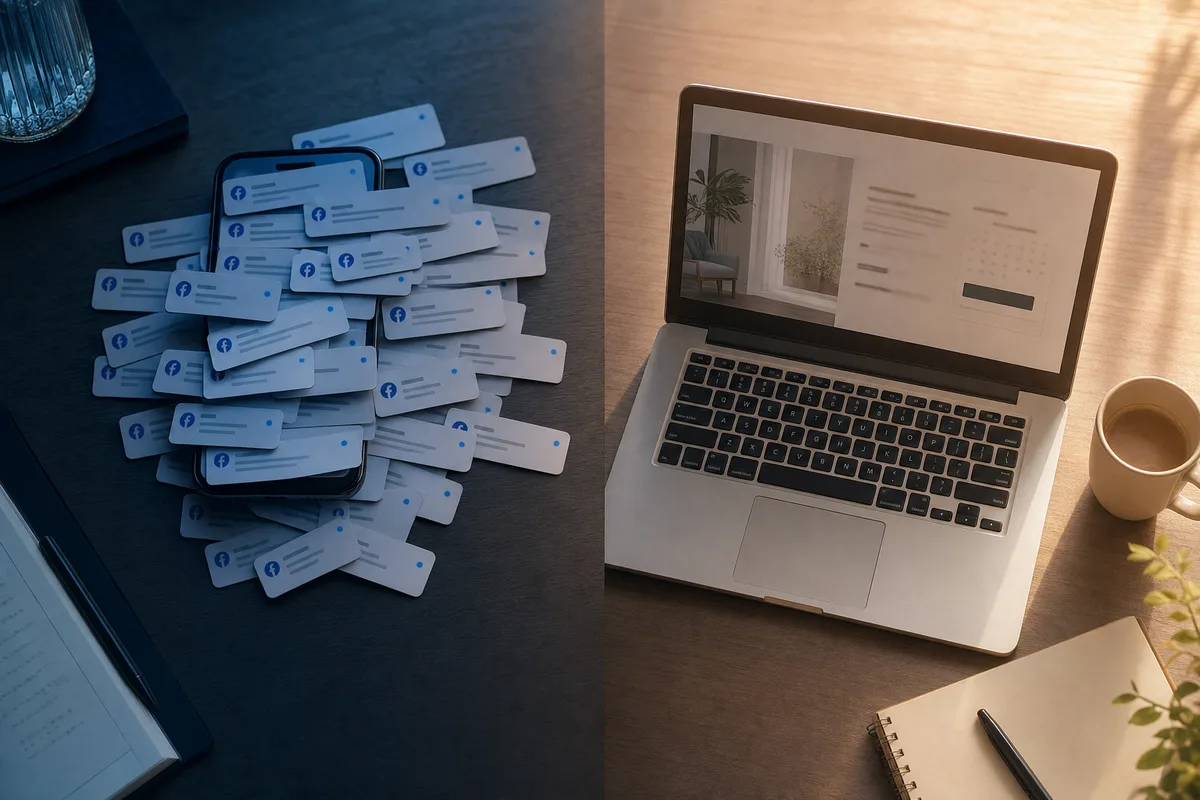
140 leads in a month. 43 answered the phone. 2 became jobs. The roofing owner who ran those ads was thrilled - $11 a lead was the cheapest cost-per-lead he’d ever seen - and he was quietly going broke on the close rate.
He was running Meta’s native instant forms. The form did exactly what it’s designed to do: collect the most contact details for the lowest cost. It was just collecting the wrong people. This is the same trap behind why cheap leads kill service businesses - the cheapest lead is rarely the cheapest client.
We build and run Meta campaigns for service businesses, and across the accounts we’ve audited this one setup choice predicts close rate better than almost any creative decision. Most owners make it by accident - they tap the option Meta nudges them toward and never question it. Below is the breakdown that actually changes the decision: what each format does to your close rate, when each one wins, and how to choose.
One thing up front, because it reframes the entire decision: the format you pick matters less than what you tell Meta to optimize toward. A landing page that reports “lead submitted” trains the algorithm almost as badly as an instant form does. That’s the fight most of this debate gets wrong - and we’ll come back to it, and to that roofer, by the end.
The Short Answer: Lead Forms vs. Landing Pages
Instant forms (Meta’s native lead forms) win on volume and cost-per-lead. Landing pages win on lead quality and cost-per-client. For most service businesses selling a considered purchase over a call - roofing, legal, dental, coaching, med spa, financial planning - the landing page produces fewer leads that are worth far more, because the small amount of friction filters out the people who were never going to buy.
If you sell a low-ticket, high-frequency service where speed and volume matter more than qualification - a $89 drain clean, a recurring cleaning, routine HVAC maintenance - instant forms can be the right call. For everything where a human has to call, qualify, and close, default to a landing page.
The rest of this guide is the “why” and the “how to decide.”
What Facebook Instant Forms and Landing Pages Actually Are
Instant forms (Facebook/Meta lead ads): The form opens inside the Facebook or Instagram app when someone taps your ad. Meta pre-fills their name, email, and phone from their profile. They tap submit without leaving the app or typing anything. The friction is almost zero, which is the entire point - and the entire problem.
Landing pages (conversion ads): The ad sends people to a dedicated page on your site built around one action - book a call, request a quote, schedule a consultation. They read your offer, then choose to fill in their details and click. The extra steps - leaving the app, loading a page, reading, typing - are friction. That friction costs you volume and buys you intent.
The difference isn’t cosmetic. It changes who ends up in your CRM.
The Tradeoff, In One Table
These are directional ranges reported across 2026 operator data and paid-social benchmarks, not guarantees. The single biggest swing factor is follow-up speed. The widely cited Lead Response Management study (James Oldroyd), popularized by Harvard Business Review, found that contacting a web lead within 5 minutes dramatically raises the odds of reaching and qualifying it versus waiting even 30 minutes - and those odds fall off a cliff after the first hour. That one variable can move every quality number in this table. The direction, though, is what stays consistent across verticals.
| Dimension | Instant Forms | Landing Pages |
|---|---|---|
| Click-to-lead rate | High (8-12%) - auto-fill removes friction | Lower (~5-7% median) - friction filters |
| Cost per raw lead | Low (~$30-35 typical) | Higher |
| Lead quality / qualification rate | 22-35% | 50-70% |
| Phone-answer rate | Low - many leads don’t remember submitting | High - they chose to engage |
| Close rate (lead → client) | Baseline | Often 2-3x higher |
| Cost per actual client | Higher than it looks | Usually lower |
| Best for | Low-ticket, high-volume, speed-driven | Considered purchases sold over a call |
Read that table top to bottom and the trap is obvious: every metric that’s easy to see (lead count, cost-per-lead) favors instant forms, and every metric that actually pays your bills (answer rate, close rate, cost-per-client) favors the landing page. If you judge your ads on the dashboard Meta shows you first, you’ll pick the option that’s quietly losing you money.
Why Are Facebook Instant-Form Leads So Low Quality?
Meta auto-fills the form because Meta is optimizing for completed forms - that’s the objective you handed it. A person scrolling their feed taps your ad out of mild curiosity, sees their details already filled in, and submits in under a second. They were never deciding to talk to a roofer. They were barely deciding anything.
That’s why instant-form leads answer the phone so rarely. When your rep calls two hours later, a chunk of them genuinely don’t remember submitting anything, or were “just looking,” or tapped by accident. We saw this clearly in one roofing account we audited: the instant form completed at 62%, but only about one in three leads answered the phone within 24 hours, and the sales rep rated barely 4 in 10 as genuinely interested. When we moved the same ads to a landing page, completion dropped to roughly 28% - less than half the volume - but answer rates more than doubled and the rep’s “worth calling back” rate jumped. Fewer leads, far higher quality.
This is the mechanism behind why your Facebook ad leads don’t answer the phone and a big driver of no-shows from Facebook ads. The form didn’t qualify anyone, so qualification falls entirely on your sales team - and they burn hours dialing people who never had intent.
Why Landing Pages Produce Fewer, Better Leads
The extra fifteen seconds is the whole point. Asking someone to leave the app, wait for a page, read your offer, and type their own number forces a conscious decision: do I actually want this business to call me? The people who say no were never going to close. The people who push through are telling you something real about their intent before your rep ever picks up the phone.
That self-selection is why landing-page leads qualify at roughly double the rate and close at 2-3x. You pay more per lead and less per client. For a service business, cost-per-client is the only number that matters, because that’s the one connected to revenue. A $35 lead that never closes is infinitely expensive; a $90 lead that closes at 12% is cheap.
A landing page also gives you something an instant form never can: control. You decide the headline, the proof, the offer, and the single action. You can match the page to the exact promise in the ad so the message carries through instead of breaking at the click. (If you’re building or fixing one of these pages, intent and message-match are everything.)
The Real Debate: What You Optimize Toward
Here’s what the volume-versus-quality argument misses, and why the format is the second decision, not the first. Meta’s algorithm only optimizes for what you let it see. If you report “lead” events back to Meta - whether they came from an instant form or a landing page - you’re training the algorithm to find more people who submit, not more people who buy. A landing page reporting shallow lead events trains the machine almost as badly as an instant form. The optimizer does its job perfectly and finds you more of the wrong people every week.
The deeper fix is to send your real outcomes back to Meta through the Conversions API (CAPI): not “lead submitted,” but “this lead booked a call” and “this one became a $14,000 job.” Now the algorithm optimizes toward people who resemble your buyers, not your form-fillers. Operators running this closed loop consistently report meaningfully lower effective cost on qualified pipeline, because Meta starts delivering toward customers instead of curiosity-clickers. It’s the same root cause behind why Meta ads generate leads but not clients - the leak is almost always the signal you feed the machine.
Picture the roofer from the top of this article. If he had reported his 2 closed jobs back to Meta instead of 140 form-fills, the algorithm would stop chasing $11 taps and start hunting for the homeowners who actually re-roof. Same ad budget, aimed at buyers instead of browsers. That is the entire difference between the two formats collapsing into one question: what outcome are you teaching Meta to find?
This closed loop is the system Camply is built around, through offline conversion optimization: a closed deal in your CRM is reported back to Meta so the algorithm learns to find more paying clients, not more cheap leads. And it matters most with instant forms, precisely because they need the most help separating real buyers from accidental taps.
How to Choose Between Facebook Lead Forms and Landing Pages
Run your situation through these three questions.
1. What’s your ticket size and sales motion? If a human has to call, qualify, and close a considered purchase (most service businesses), use a landing page. If it’s a low-ticket, transactional, speed-wins service - emergency drain clear, recurring cleaning, routine maintenance - instant forms can win because volume and response speed matter more than qualification.
2. Can your team handle the volume - and the junk? Instant forms will flood you with leads, many low-intent. If you have an SDR or fast automation that can dial within 5 minutes (which raises conversion dramatically either way), you can work that volume. If your owner is the salesperson and time is scarce, fewer, higher-intent landing-page leads protect the one resource you can’t scale: selling time.
3. Do you have a closed loop? If you can report booked calls and closed deals back to Meta via CAPI, you can run either format more aggressively because the algorithm self-corrects toward buyers. Without a closed loop, instant forms are the riskiest choice - you’re optimizing blind toward the cheapest, lowest-intent leads.
For most service businesses reading this, the answer lands on: landing page, deep conversion event, CAPI connected. That’s the structure that produces clients instead of a busy, broke dashboard.
If You Must Use Instant Forms, Do This
Sometimes instant forms are right, or you want to test them as a top-of-funnel layer. Don’t run the default form. Close the quality gap on purpose:
- Switch from the “more volume” form to the “higher intent” form. This adds a confirmation step that removes accidental submissions. It costs you some volume and saves you hours of dead dials.
- Add qualifying questions. “Are you the homeowner?” “What’s your budget range?” “When do you need this done?” Qualifying questions filter out a large share of junk before it reaches your team.
- Optimize for conversion leads, not just leads. Once you have enough data, switching the objective to conversion-quality leads improves the people Meta sends you.
- Connect CAPI and report booked calls. Same principle as everywhere in this guide - feed the algorithm your real outcomes so it stops chasing form-fillers.
- Call within 5 minutes. Speed-to-lead is the highest-leverage fix for instant-form leads specifically, because their intent fades fast. The longer you wait, the less they remember why they tapped.
The Bottom Line
For a service business, the landing page almost always wins on the number that actually matters - cost per client - because a few seconds of friction is the cheapest lead-qualification you’ll ever buy. Instant forms only pull ahead when the job is low-ticket and speed beats screening.
Whichever you run, the multiplier is the same: report your actual results back to Meta so the algorithm learns to find buyers. That closed loop is the difference between ads that decay and ads that compound. Camply builds the whole system around it - ICP-driven creative, campaign structure, and closed-loop CAPI - so your ads optimize for closed clients, not cheap leads.
Frequently Asked Questions
Are Facebook lead forms or landing pages better for service businesses?
For most service businesses - those selling a considered purchase closed over a call (roofing, legal, dental, coaching, med spa, financial planning) - landing pages are better. They produce fewer leads but qualify at roughly double the rate and close at 2-3x, which lowers your cost per actual client. Instant forms are better only for low-ticket, high-volume, speed-driven services where qualification matters less than response speed and volume.
Are Facebook lead forms worth it?
For low-ticket, high-volume services where speed beats screening - emergency drain clears, recurring cleaning, routine maintenance - yes, instant forms can be worth it. For anything sold over a call (most service businesses), they’re usually a false economy: the cheap cost-per-lead hides a high cost-per-client once you count the leads that never answer or close. They become worth it again the moment you add qualifying questions, call within 5 minutes, and report closed deals back to Meta via CAPI so the algorithm chases buyers instead of form-fillers.
Why are my Facebook instant-form leads so low quality?
Because Meta auto-fills the form with profile data, people can submit in under a second without genuine intent - sometimes by accident. You optimized for completed forms, so Meta finds people who complete forms, not people who buy. The fix is to add qualifying questions, use the higher-intent form variant, call within 5 minutes, and report your real outcomes (booked calls, closed deals) back to Meta via CAPI so the algorithm optimizes toward buyers.
Do landing pages really cost more per lead?
Usually yes - landing-page leads cost more per raw lead because the friction reduces volume. But they cost less per client, because the leads that push through have higher intent and close at a much higher rate. Cost per client, not cost per lead, is the number that connects to revenue for a service business.
Can I use both instant forms and landing pages?
Yes, and sophisticated advertisers often do: a landing page as the primary conversion path, with instant forms tested as a top-of-funnel awareness layer (a minority of budget). The key is to never judge them on the same metric - measure each on cost per qualified, closed client, and feed both back to Meta through CAPI so the algorithm learns from real outcomes.
What’s the most important setting either way?
The conversion event you optimize for and whether you close the loop. Optimizing for a shallow event (form fill) trains Meta to find form-fillers. Optimizing for a deep event (booked call) and reporting closed deals back through the Conversions API trains it to find buyers. That single decision moves your results more than the form-versus-page choice itself.
Related Articles
AI Facebook Ads in 2026: What AI Actually Does (and What It Still Can't)
A clear, honest guide to AI Facebook ads in 2026 - how Meta's own AI (Andromeda and Advantage+) now runs delivery, which AI tools you actually control, what AI does brilliantly, what it still can't do, and how to use it to book clients instead of burning budget.
Are Facebook Ads Worth It in 2026? An ROI Breakdown for Service Businesses
Are Facebook ads worth it in 2026? A clear ROI breakdown for service business owners - the real cost-per-client math, a break-even calculator by client value, and the honest checklist for when they pay off and when they don't.
Best AI Marketing Tools for Local Service Businesses (2026)
We evaluated 5 AI marketing tools through the lens of what service businesses actually need: ICP profiling, booked-call funnels, and closed-loop revenue optimization. Here's what each tool actually does — and what it doesn't.
Facebook Ads for Auto Repair Shops (2026): Book High-Value Jobs, Not Oil-Change Coupons
Most auto repair Facebook ads attract coupon-hunters who never come back. Here's how to structure campaigns that win the trust of car owners and book the high-margin diagnostic, brake, and major repair work that actually grows the shop.
Facebook Ads for Chiropractors (2026 Guide)
Most chiropractic Facebook ads generate cheap leads that never book an appointment. Here's the strategy that aligns campaigns with how patients actually choose a chiropractor — and how to build a funnel that drives real consultations and revenue.